Skip to content
The Big Blue Zrmanja
  • Home
  • BOAT TOURS
    • DAILY TOUR
    • PRIVATE TOURS
    • GROUP TOURS
    • TEAM BUILDING
    • SPECIAL OCCASIONS
  • THE ROUTE
  • SVETI ANTE
  • ABOUT US
  • FAQ

PRIVACY & COOKIE POLICY

Last updated: 10 September 2026

The big blue Zrmanja respects your privacy and is committed to protecting your personal data. This Privacy & Cookie Policy explains how we collect, use and protect personal data when you visit our website, contact us or submit a booking request.

1. Who is responsible for your data?

The data controller is:

THE BIG BLUE, obrt za elektroinstalacije i pomorski prijevoz putnika, vl. Branimir Šestak
Obala K. E. Kotromanić 59
23312 Novigrad, Croatia
OIB: 56687633889

Email: info@big-blue-zrmanja.hr
Phone: +385 99 2057 767

2. What personal data do we collect?

When you contact us or submit a booking request, we may collect:

  • name and surname
  • email address
  • phone / WhatsApp number
  • preferred tour and date
  • number and age categories of guests
  • messages, special requests or other information you choose to provide

Our website may also process technical information necessary for its operation and security, such as IP address, browser and device information.

3. Why do we use your personal data?

We use personal data to:

  • respond to your enquiries
  • process and manage booking requests
  • check availability
  • communicate with you about your tour
  • provide the requested service
  • comply with legal obligations
  • maintain the security and proper functioning of our website

The legal basis for processing depends on the purpose and may include taking steps at your request before entering into a contract, performance of a contract, compliance with a legal obligation, legitimate interests where applicable, or your consent where consent is required.

4. How long do we keep your data?

We keep personal data only for as long as necessary for the purpose for which it was collected.

Where certain information must be retained for accounting, tax or other legal purposes, it will be kept for the period required by applicable law.

5. Who may have access to your data?

We do not sell your personal data.

Personal data may be processed by service providers necessary for the operation of our website and business, such as our website hosting and email providers.

Personal data may also be disclosed where required by applicable law or a competent public authority.

6. Your rights

Under the GDPR, depending on the circumstances, you may have the right to:

  • access your personal data
  • correct inaccurate or incomplete personal data
  • request deletion of your personal data
  • restrict certain processing
  • object to certain processing
  • request data portability where applicable
  • withdraw your consent at any time where processing is based on consent

To exercise your rights, contact us at:

info@big-blue-zrmanja.hr

You also have the right to lodge a complaint with the Croatian Personal Data Protection Agency (AZOP).

AZOP specifically requires privacy information to explain the controller, purposes and legal bases, recipients, retention, data-subject rights and other applicable information, so these aren’t just filler sections.

7. Cookies

Cookies are small files that may be stored on your device when you visit a website.

Our website may use cookies that are strictly necessary for the website to function properly. These cookies do not require your consent when they are necessary to provide the website or a service you have requested.

If we use analytics, marketing or other non-essential cookies, they will not be activated before you have given your consent.

When you first visit our website, the cookie banner allows you to accept or reject non-essential cookies and, where applicable, manage your preferences.

You may withdraw or change your consent at any time using the cookie consent mechanism available on the website.

This distinction matters: under the current Croatian guidance, non-essential cookies generally require prior consent, while strictly necessary cookies are exempt. AZOP also requires the first banner layer to make accepting and rejecting cookies equally straightforward.

8. Third-party services

Our website may contain links to third-party websites and services, including Google Maps, Facebook and Instagram.

If you follow an external link or interact with a third-party service, that provider may process your personal data according to its own privacy policy.

9. Data security

We take appropriate technical and organisational measures to protect personal data against unauthorised access, alteration, disclosure, loss or misuse.

10. Changes to this policy

We may update this Privacy & Cookie Policy if our website, services or legal obligations change.

The latest version will always be available on this page.
The big blue Zrmanja

Boat tours from Novigrad across three seas and into the spectacular Zrmanja River Canyon.

CONTACT

Novigrad, Dalmatia, Croatia
+385 99 2057 767
info@big-blue-zrmanja.hr

LEGAL

Privacy & Cookie Policy
Booking Terms

© 2026 The big blue Zrmanja. All rights reserved.

THE BIG BLUE, obrt za elektroinstalacije i pomorski prijevoz putnika, vl. Branimir Šestak · Obala K. E. Kotromanić 59, 23312 Novigrad, Croatia · OIB: 56687633889

  • Facebook
  • Instagram

KARIN SEA

COULD THIS BE THE WORLD’S SMALLEST SEA?

The Karin sea is the smallest of the three seas on our journey — a tiny, almost completely enclosed body of seawater covering just 5.47 km².

Connected to the Novigrad sea by the narrow Karinsko ždrilo, it is only 3 to 12.5 metres deep. Like the Novigrad sea, it was created when rising sea levels flooded part of the ancient Zrmanja river valley thousands of years ago.

Despite its size, this little corner of the Adriatic has long been known as a sea. Historical maps using the name Karin sea date back to at least 1781.

And that has led to an interesting question: could the Karin sea actually be the smallest sea in the world?

DID YOU KNOW?

It is far smaller than the sea usually given that title.

The Marmara sea in Turkey is commonly described as the world’s smallest sea, yet it covers around 11,500 km². The Karin sea covers less than 6 km².

A local initiative has even been working towards having the Karin sea officially recognized as the world’s smallest sea.

Official title or not, sailing across an entire sea this small is something you don’t get to do every day.

WINNETOU & ZRMANJA

WHEN ZRMANJA BECAME THE WILD WEST

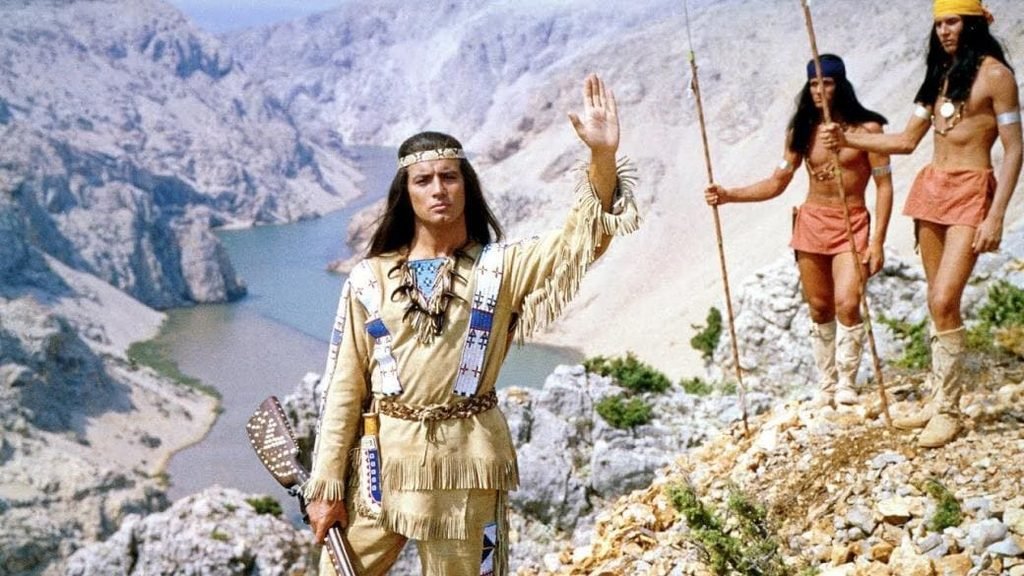
During the 1960s, the dramatic landscapes of Croatia became the backdrop for the legendary Winnetou films, based on the adventure novels of German writer Karl May.

The Zrmanja Canyon played a particularly memorable role. On screen, the river became the Rio Pecos, while the plateau high above the canyon at Pariževačka glavica became the home of Winnetou and his Apache tribe. It was here that Winnetou, played by Pierre Brice, and Old Shatterhand, played by Lex Barker, became blood brothers.

Several Winnetou films used the Zrmanja as a filming location, including Winnetou I, Winnetou III, Old Surehand I and Winnetou and Shatterhand in the Valley of Death.

And some of those scenes were filmed right along the river we are cruising today. Near the mouth of the Zrmanja and further upstream, scenes involving Old Shatterhand and Intschu-tschuna were filmed, as well as the spectacular sequence of bandits travelling on rafts along the burning Rio Pecos.

DID YOU KNOW?

The American Wild West was actually Croatia.

For millions of European cinema-goers, these Croatian landscapes became the American frontier. Zrmanja was Rio Pecos, and locations around Paklenica, Velebit, Plitvice and Krka became part of Winnetou’s Wild West

More than sixty years later, the scenery is still here — and today, you are travelling through it by boat.

NOVIGRAD MUSSEL

SHAPED BY THE SEA. FED BY THE RIVER.

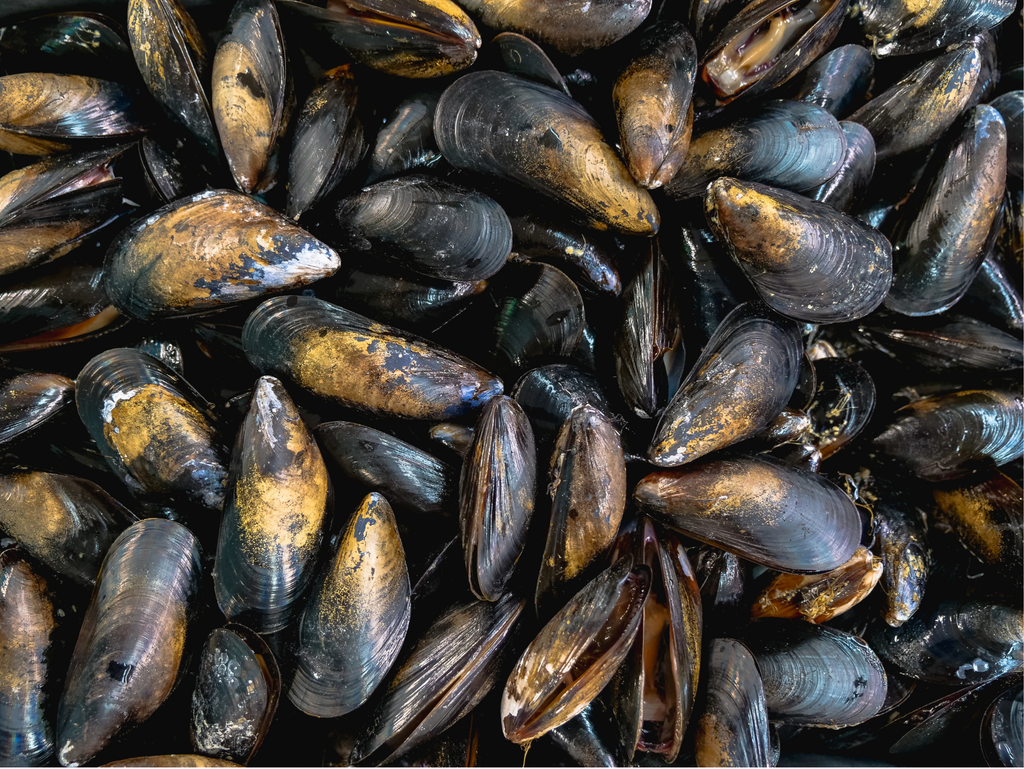
The Novigrad mussel (Novigradska dagnja) is much more than a local delicacy. Grown in the Novigrad sea and Novsko ždrilo, it has become one of the defining flavours of this small corner of Dalmatia.

Part of its secret lies in the unusual environment around us. The Zrmanja river brings freshwater and nutrients into the Novigrad sea, while other freshwater sources and rainfall from the surrounding landscape also enrich these sheltered waters. This creates favorable conditions for phytoplankton and zooplankton — the natural food on which mussels feed by continuously filtering seawater.

The result is a mussel particularly known for its high meat content, with a soft, elastic texture and the characteristic aroma of the sea and marine algae. Its connection to this specific environment is so important that “Novigradska dagnja” is protected at EU level with a Protected Designation of Origin (PDO).

DID YOU KNOW?

A Novigrad mussel is a tiny natural water filter.

Mussels feed by continuously filtering the water around them, collecting microscopic plankton and other naturally occurring particles. The nutrient-rich waters of the Novigrad sea provide particularly favorable feeding conditions — one of the reasons these mussels develop their characteristic quality and high meat content.

So while we cross the Novigrad sea towards the Zrmanja, the river is already part of the story — long before we actually enter it.

NOVIGRAD

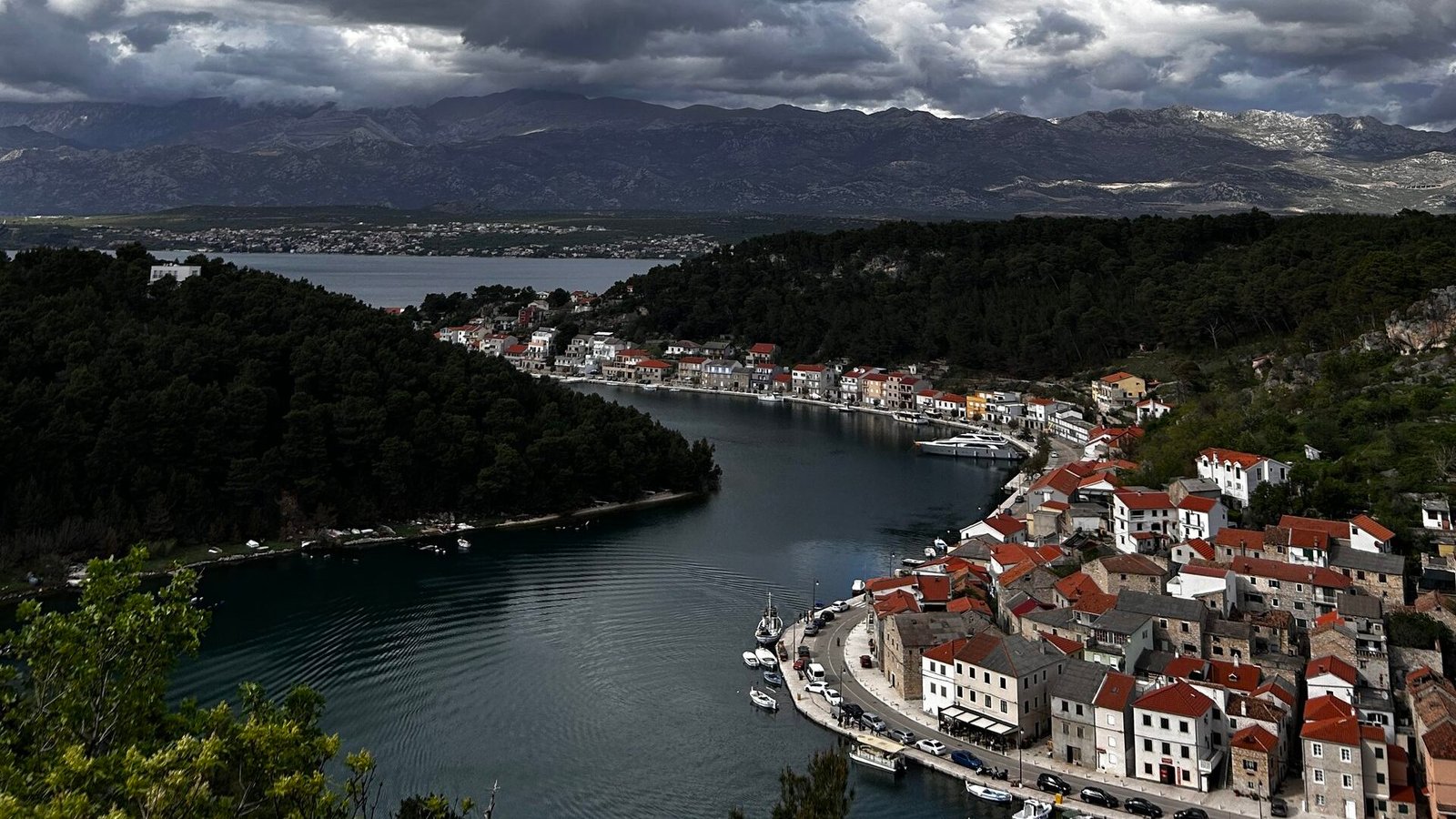
At first glance, Novigrad is a quiet Dalmatian fishing village, tucked away at the end of a sheltered sea. But behind its stone houses, narrow streets and peaceful waterfront lies a story that stretches back thousands of years.

Long before the village took the shape we know today, this naturally protected area was already inhabited. A Liburnian hillfort once stood above the bay, and the strategic importance of the location continued through Roman times and into the Middle Ages.

High above the village, the remains of Fortica still tell part of that story. The medieval fortress became the scene of one of the most dramatic chapters in Novigrad’s history. In the late 14th century, during a violent struggle for the Hungarian-Croatian throne, Queen Mary and her mother, Queen Elizabeth, were imprisoned here. Elizabeth never left the fortress alive.

Through the centuries that followed, Novigrad found itself between powerful interests, wars and changing rulers. Yet beneath all that history, everyday life continued to revolve around the sea. Fishing, shellfish farming and life on the water shaped generations of local families and remain an important part of the village’s identity today.

Perhaps that is what makes Novigrad so special. Its history isn’t hidden behind museum walls. It is still there — in the fortress above the village, in its old stone streets, along the waterfront and in stories that have been passed from one generation to the next.

DID YOU KNOW?

In 1936, even a king had to bargain with a Novigrad fisherman.

King Edward VIII and Wallis Simpson sailed into Novigrad aboard their yacht and spent time walking along the waterfront. According to a story preserved locally, Edward spotted an unusually large lobster caught by fisherman Augustin Maroja and decided he wanted to buy it. There was only one problem: Augustin had his price — and the King had his. Neither was willing to give in, so the royal visitor sailed away without his lobster. Apparently, being a king didn’t get you a discount in Novigrad. 😉

A village of fishermen, queens and kings — and this is only the beginning of our journey.

MASLENICA BRIDGES

TWO BRIDGES. ONE REMARKABLE STORY.

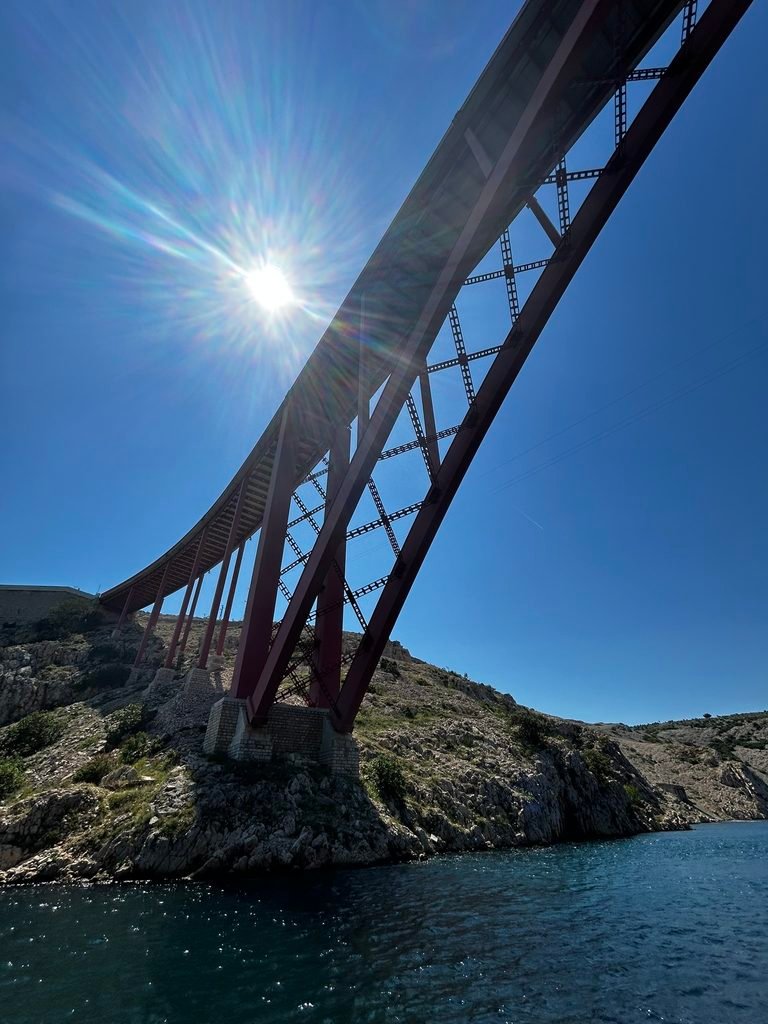
As we cruise through Novsko Ždrilo, two bridges rise high above us. They may appear to be two neighbouring pieces of infrastructure, but together they tell more than sixty years of local history.

The original Maslenica Bridge opened in 1961, carrying the Adriatic Highway high above Novsko Ždrilo. During the Croatian War of Independence, it was destroyed on 21 November 1991, severing one of the key road connections between northern and southern Croatia.

After Operation Maslenica in January 1993, a temporary pontoon bridge was built across Novsko Ždrilo. A new concrete motorway bridge was later constructed about 1.5 kilometres farther north and opened in 1997.

The original crossing was eventually restored with a new steel arch bridge, opened in 2005 — bringing back the familiar silhouette of the Maslenica Bridge above the gorge.

DID YOU KNOW?

The bridge that looks older is actually younger.

The steel arch bridge standing on the historic crossing opened in 2005, while the larger concrete motorway bridge opened in 1997 — eight years earlier. So the bridge commonly thought of as the “old” Maslenica Bridge is actually the younger of the two you see today. 😉

Two bridges above us — and more than six decades of history in a single view.

English